How to Start a Marketing Agency in Australia: A Free ABN and $636 Open the Door — Compliance and Pricing Keep It Open
Starting a marketing agency in Australia costs less than a decent laptop: the paperwork is genuinely minimal, and no regulator checks whether you can actually market anything. That open door explains the crowd — and why survival is decided by the three disciplines nobody registers: pricing, compliance and focus. Here's the honest 2026 setup.
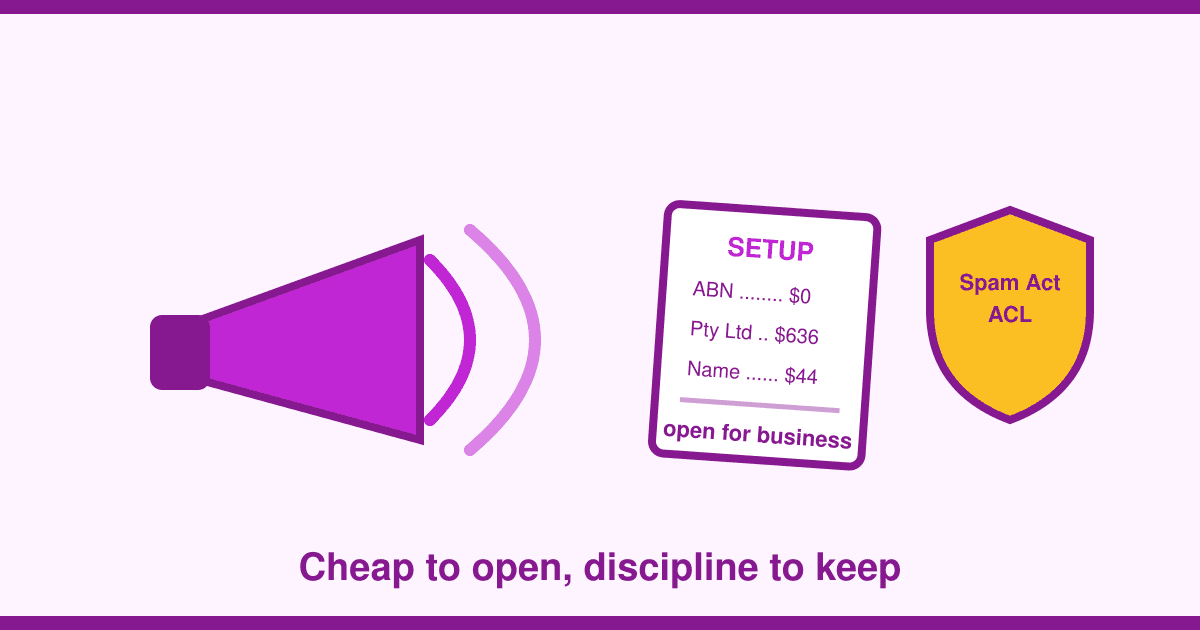
In short: The formal layer is quick: an ABN is free from abr.gov.au, registering a Pty Ltd costs $636 (ASIC fee, 2026–27), a business name $44 a year (or $102 for three), with a $310 annual ASIC review thereafter and GST registration mandatory — and free — from $75,000 turnover. The binding layer is legal, not licensing: the Spam Act 2003, Privacy Act 1988 and Australian Consumer Law apply to everything you'll send, store and claim — and professional indemnity insurance is the standard companion. Case studies, not certificates, are the credentials.
The setup ledger
| Item | Cost (2026) |
|---|---|
| ABN | Free — abr.gov.au |
| Pty Ltd registration | $636 ASIC fee (2026–27) |
| Business name | $44 / 1 yr · $102 / 3 yrs |
| ASIC annual review | $310 / yr |
| GST registration | Free — mandatory from $75,000 turnover |
| Professional indemnity insurance | The standard risk companion — priced to your services |
Compliance is a deliverable, not a footnote
Here's what separates agencies from freelancers-with-logos in Australia: your clients' legal exposure runs through you. Every email campaign you send touches the Spam Act — the consent and unsubscribe rules agencies are hired to know; every testimonial and influencer post touches ACCC rules — the disclosure requirements agencies routinely get wrong; every database you build touches the Privacy Act, and every performance claim the Australian Consumer Law. The new agency that treats this stack as a selling point — compliant campaigns as the default deliverable — turns Australia's regulatory layer into its cheapest differentiator.
The disciplines that decide survival
- Price cost-up, not competitor-down: estimate the hours each role genuinely needs, cost them fully loaded, add direct expenses, then apply a real gross margin against realistic utilisation — no team sells all its hours. Retainers priced from competitor screenshots produce politely loss-making clients by month six.
- Niche before name: channel × industry — "paid social for hospitality" — beats full-service-for-everyone. Specialists get referred and compared on fit; generalists get compared on price. Your prospects are literally reading how to choose an agency before they call — be the obvious answer to a narrow question.
- Contracts that build trust: clear scope, defined reporting, and client ownership of ad accounts and data — the account-hostage move is the industry's worst habit and abandoning it is free. What a good retainer relationship looks like is your contract template written from the client's side.
- Sell weekly: pipeline work every week or the agency lurches between feast and famine — the most common cause of death after underpricing. Referrals inside the niche compound; everything outside it is noise.
Growth, in the right order
Solo → subcontractors → first hire, gated by genuine over-demand at healthy margins rather than by one big client making you feel rich. Productise early — audit, launch, monthly program — because defined packages quote faster and train clients out of scope creep (your quoting sanity check: clients comparing your web work against real website cost benchmarks can smell a padded quote). And keep the concentration rule: an agency whose largest client stays under a quarter of revenue survives surprises; one client at half your book is an outsourced department with extra steps.
The honest differentiator in 2026: every Australian SME you pitch has been burned by an agency that over-promised and under-reported. Conservative promises, transparent reporting and visible compliance beat flashier competitors more reliably than any award — trust is the scarcest commodity in this market, and it compounds like the retainers do.
The bottom line
A free ABN, $636 for the company, $44 for the name — the door is open by Friday. Staying inside: cost-up pricing at honest utilisation, the Spam Act/ACCC/Privacy stack treated as a deliverable, a referrable niche, and weekly pipeline work. Enter cheap, price like a business, and let compliance be the moat licensing never built. Get listed where Australian businesses compare agencies here.
Frequently asked questions
No — no licence or qualification is required. The formal setup is an ABN (free), optionally a Pty Ltd company ($636 ASIC registration fee, 2026–27) and a business name ($44 a year), with GST registration mandatory and free from $75,000 turnover. Case studies, not certificates, are the working credentials.
The registrations are minimal: free ABN, $636 for Pty Ltd registration, $44 a year for a business name, then a $310 annual ASIC review. The real budget items are professional indemnity insurance, tools and the months of runway while the client base builds.
The Spam Act 2003 (consent and unsubscribe rules for email/SMS), the Privacy Act 1988 (client databases and personal information), and the Australian Consumer Law with ACCC rules on reviews, testimonials and influencer disclosure. Agencies that build compliance into delivery turn this stack into a differentiator.
Underpricing and empty pipeline, rarely lack of marketing skill. Retainers copied from competitors instead of priced cost-up produce loss-making clients, and founders who only sell when a retainer cancels lurch between feast and famine. Cost-up pricing, a narrow niche and weekly pipeline work are the survival disciplines.